Weekend Itinerary
Niagara Falls Weekend Itinerary: Planning a Two-Day Ontario Trip
A practical two-day planning itinerary for Niagara Falls, Ontario, separating natural gorge viewing from mid-way attractions, with clear transit, parking, and seasonal advice.
canadaguides.ca editorial desk · August 8, 2026 · 8 min read
Plan your visit
- Best season
- May to October for full attraction access; autumn for lower crowds
- Getting around
- WEGO visitor bus network or local walking along paved river trails
- Cost range
- Free riverfront viewing; ticketed admission for inner gorge attractions
- Trip duration
- Two full days for city attractions, gorge trails, and wine country
- Transit connection
- GO Transit rail service connects Toronto Union Station to Niagara Falls
- Accessibility
- Paved barrier-free main promenade and fully accessible WEGO buses
A weekend trip to Niagara Falls works best when you separate the conservation land along the gorge from the commercial strip above it. Our advice: do not try to squeeze every attraction into one day, which can leave you stuck in traffic along Fallsview Boulevard or paying extra for multiple parking stops. Splitting your two days between the Niagara Parks riverfront and the surrounding region—including Niagara-on-the-Lake—gives you a far better experience. This guide helps you choose where to focus your time and how to get around efficiently.
In short: Spend your first day on the river level using Niagara Parks transit to visit the Horseshoe Falls, boat tours, and gorge walks. Reserve your second day for the Clifton Hill mid-way, local viewpoints, and a afternoon tasting trip into nearby wine country.
Fees, transit fares, schedule times, and seasonal opening dates in the region change frequently throughout the year. To ensure you have accurate information before travel, this guide points directly to official government, transit, and park management websites for all current pricing and operational details.
Niagara Falls attractions compared
| Attraction | Best for | Suits | Typical visit | Cost type | Parking | Stroller access | Best season |
|---|---|---|---|---|---|---|---|
| Journey Behind the Falls | Up-close cascade views | All ages | A couple of hours | Paid ticket | Paid, off-site | Fully accessible | Year-round |
| Niagara City Cruises | Gorge boat experience | All ages | A couple of hours | Paid ticket | Paid, off-site | Stroller accessible | Spring to autumn |
| White Water Walk | Watching class 6 rapids | School age and up | Quick stop | Paid ticket | On-site paid | Elevator accessible | Spring to autumn |
| Whirlpool Aero Car | Aerial gorge views | Teens and adults | Quick stop | Paid ticket | On-site paid | Steps required | Seasonal |
| Clifton Hill Mid-Way | Family entertainment | Toddlers and kids | Half day | Paid attractions | Paid lots | Fully accessible | Year-round |
| Niagara Glen Nature Reserve | Hiking gorge trails | Teens and adults | Half day | Free | Paid parking lot | Rugged stairs only | Spring to autumn |
Our picks
Our recommendations are based on practical ease, transit access, and value for time when exploring the Niagara river corridor.
- Best for toddlers: Niagara Parks Power Station and Tunnel, where wide, smooth concrete walkways allow easy stroller roll, and interactive lighting keeps younger children engaged without overwhelming noise.
- Best for older kids: White Water Walk, providing an eye-level look at massive river rapids from a secure boardwalk anchored to the gorge wall.
- Best free option: Niagara River Parkway Promenade, offering kilometers of paved, barrier-free walking trails directly facing the American and Horseshoe Falls.
- Best rainy-day option: Butterfly Conservatory, an indoor climate-controlled glasshouse filled with tropical plants and thousands of free-flying butterflies.
- Best full-day outing: Niagara Parks Waterfront Route, combining the river boat tour, Table Rock Centre, and the scenic gorge boardwalk using local transit.
The two-day weekend itinerary: Niagara Parks and Beyond
Day 1: The Falls and the Niagara Gorge
Start early at Table Rock Centre to view the brink of the Horseshoe Falls before peak mid-day foot traffic arrives. Head inside to experience Journey Behind the Falls, where elevators lower you through bedrock to viewing portals directly behind the thunderous water curtain.
From Table Rock, head north along the river shuttle route toward Niagara City Cruises. The boat takes passengers right into the mist basin of the Horseshoe Falls. Afterwards, continue north down the river road to the White Water Walk. Walking along this boardwalk gives a clear perspective on the river's power as it surges through the narrowest section of the gorge.
End your day back near Table Rock as night falls. The cascades are illuminated every evening by colored floodlights mounted along the Canadian riverbank, followed by seasonal evening fireworks displays over the gorge.
Day 2: Clifton Hill, Viewpoints, and Wine Country
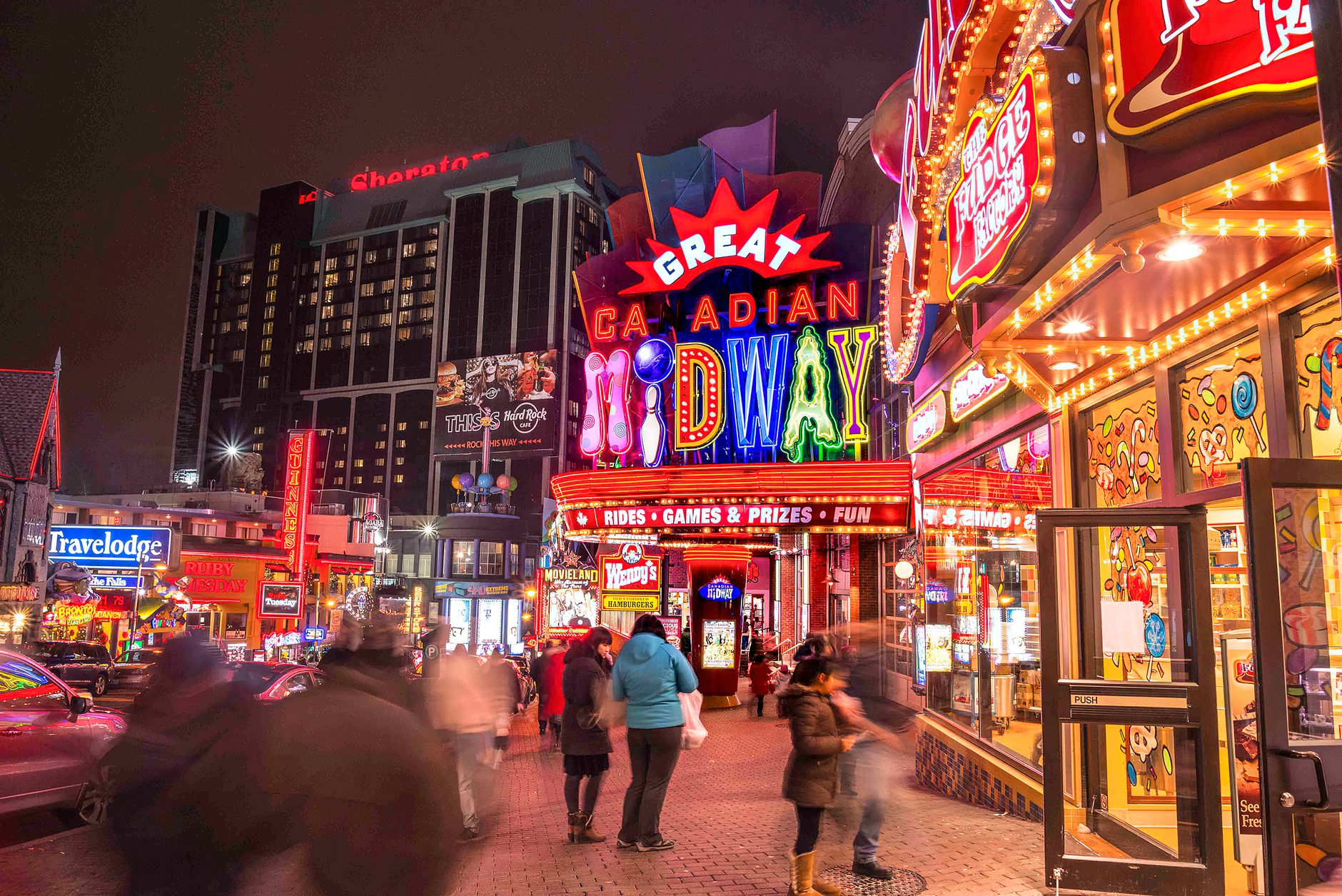
Spend your morning exploring the Clifton Hill mid-way district. This high-density entertainment strip features giant Ferris wheels, mini-golf, wax museums, and themed arcades. It is lively and entertaining for children, though dining options directly on the strip are geared toward fast food.
Later in the day, shift away from the city center and travel north along the scenic river parkway toward regional destinations like Niagara-on-the-Lake. The parkway winds past fruit orchards, historic battlefields, and dozens of estate wineries. Spend the afternoon walking through the historic streetscape of Queen Street in Niagara-on-the-Lake, visiting local boutique shops, or booking a tasting flight at a farm vineyard in the Niagara Benchlands.
For additional ideas on exploring beyond the main strip, read our detailed guide on things to do in Niagara Falls, Ontario.
Getting to Niagara Falls and moving around
Reaching the city from Toronto or Hamilton is straightforward via the Queen Elizabeth Way (QEW). We recommend taking public transit or travelling off-peak to avoid potential summer weekend highway delays near the Garden City Skyway.
Public transit is a practical alternative during busy summer months. GO Transit offers regional train and bus connections linking the Toronto area and intermediate hubs to Niagara Falls. The train station sits in the historic downtown area, north of the main hotel districts.
Once in town, leave your car parked. The WEGO bus system serves as a visitor transit network connecting local hotel districts with Niagara Parks attractions along the riverfront. Buses run on fixed, color-coded lines:
- Green Line: Follows the riverfront corridor, serving key waterfront parks attractions.
- Red Line: Connects outlying hotel districts to the central falls viewing area.
- Blue Line: Links the upper hotel district with the main entertainment district.
Transit passes can be purchased individually or included inside bundled attraction packages. Check official transit pages for current fare details before heading out.
Parking reality and lot options
Driving directly up to Horseshoe Falls without a parking strategy usually leads to frustration. On-site parking at Table Rock Centre (Lot A) is convenient but commands the highest local daily rates, and spaces fill rapidly on summer mornings.
We recommend using the official Niagara Parks long-term lot at Rapidsview (Lot P1), located south of the main falls area. Parking here includes a quick shuttle ride on the WEGO Green Line right to the brink of the Horseshoe Falls, saving you money and hassle.
City-operated street meters and private surface lots line Clifton Hill and Fallsview Boulevard. Private lot prices fluctuate wildly based on weather, special events, and time of day. Always check the posted rate board before pulling through any private gate. Check the City of Niagara Falls parking page for municipal lot maps and current rates.
Costs, tickets, and pass bundles
A weekend trip can range from low-cost sightseeing to high-budget entertainment depending on your itinerary choices. Viewing the falls from the public parkway trail costs nothing, making self-guided walking one of the best experiences in the province.
If you plan to visit multiple paid sites—such as the boat cruise, behind-the-falls tunnel, power station, and gorge boardwalk—purchasing a bundled pass from Niagara Parks saves money compared to individual tickets. Pass options change by season:
- Summer Passes: Include access to core gorge attractions, historical sites, and consecutive-day WEGO transit access.
- Winter Passes: Cover indoor attractions like the Butterfly Conservatory, Power Station, and Journey Behind the Falls at reduced seasonal pricing.
Review current pass inclusions and single-ticket pricing on the official Niagara Parks website.
Families and kids in Niagara
Travelling with children requires balancing active sightseeing with regular downtime. The paved walking promenade alongside the river is wide and smooth, making it ideal for strollers and wagons. Accessible washrooms and nursing spaces are available at Table Rock Centre and the Niagara Parks Power Station.
Clifton Hill provides major sensory engagement with bright lights, arcade sounds, and indoor street rides. It is fun for young kids, but expect heavy foot traffic during afternoon hours. If your children need open green space to run around, head south along the parkway to Queen Victoria Park or north to the lawn spaces around the Floral Clock.
Food options directly along the tourist strips favor standard chain restaurants. For quieter family dining, consider moving inland toward Victoria Avenue or driving into downtown Niagara Falls along Queen Street.
Accessibility on the gorge edge
The public areas along the top of the Niagara Gorge offer excellent physical accessibility. The paved barrier-free trail runs continuous along the riverfront, featuring lowered stone retaining walls for wheelchair visibility.
Key accessible facilities include:
- Table Rock Centre: Equipped with wide entry ramps, automatic doors, multi-level elevators, and accessible washrooms.
- Journey Behind the Falls: Reached via large elevators; the observation decks and tunnels are flat, smooth, and accessible to mobility devices.
- WEGO Transit: Buses on these routes offer accessible low-floor boarding and dedicated space for mobility devices.
Note that natural hiking trails down inside the Niagara Glen Nature Reserve feature steep, unpaved terrain and iron staircases that are not suitable for strollers or wheelchairs. For detailed accessibility guides, inspect the main Niagara Parks Accessibility page.
Seasonality and when to visit
- Summer (June to August): Expect full access to all river boat tours, outdoor gorge walks, and aerial rides. Days are warm, but crowds and border crossing traffic are at their highest. Advance attraction reservations are essential.
- Autumn (September to November): Our preferred time for a visit. Summer tourist traffic thins out, air temperatures drop to comfortable walking ranges, and autumn leaves light up the Niagara Gorge walls. Wineries in nearby Niagara-on-the-Lake begin their annual grape harvest.
- Winter (December to February): The mist from Horseshoe Falls freezes onto surrounding trees and cliff walls, creating dramatic ice formations. The annual Winter Festival of Lights illuminates the parkway. While seasonal outdoor gorge walks close, indoor venues like the Butterfly Conservatory and Power Station remain open year-round.
- Spring (March to May): A quiet transition season with blooming spring tulips in Queen Victoria Park and melting ice along the river. Outdoor attractions begin opening progressively depending on ice conditions on Lake Erie.
To discover broader regional ideas across the province, explore our Ontario travel hub and our main Niagara Falls guide.
Beyond the falls: Niagara-on-the-Lake and the Bench
Taking a half-day detour away from the city center gives a full picture of the region's agricultural landscape. Driving north along the Niagara Parkway brings you to Niagara-on-the-Lake, a preserved nineteenth-century town on the shore of Lake Ontario.
The surrounding area forms the core of Ontario's wine industry. Dozens of estate wineries offer tours and tastings, specializing in cool-climate varieties such as Riesling, Chardonnay, Cabernet Franc, and traditional Icewine. If you prefer craft beer or cider, several farm-based microbreweries line the country roads near Virgil and Jordan.
What to know before you go
- Prepare to get wet: Mist from the Horseshoe Falls blows unpredictably across the public promenade and boat decks depending on wind direction. Bring a waterproof shell, or keep lightweight ponchos handy.
- Border crossing requirements: An international bridge connects downtown Niagara Falls directly to the United States. If you plan to cross into the United States during your weekend, carry valid passports for all travellers and check border delay updates via the Federal Bridge Corporation.
- Pack walking footwear: Even if you rely on the WEGO bus system, a standard weekend involves several kilometers of walking along paved stone paths.
- Book attraction slots early: Our advice: reserve your timed entrance online through official sites to avoid waiting in ticket queues on peak summer weekends.
Questions travellers ask
- How do I get around Niagara Falls without a personal vehicle?
- The dedicated WEGO visitor bus system connects main hotel corridors on Lundy's Lane, Victoria Avenue, and Fallsview directly to all Niagara Parks attractions along the river road. Single-day and multi-day transit passes are available.
- Can I visit Niagara Falls on a weekend trip from Toronto by train?
- Yes. GO Transit operates rail service on the Lakeshore West line directly between Toronto Union Station and Niagara Falls GO Station, supplemented by regional bus links. From the Niagara station, local transit connects directly to the tourist district.
- What is the best way to handle parking near Horseshoe Falls?
- Avoid driving directly to Table Rock Centre during peak hours. Use the official long-term Rapidsview Lot (Lot P1) located south of the falls and take the included WEGO Green Line shuttle directly to the brink.
- Are the major viewing areas around Niagara Falls accessible for strollers and wheelchairs?
- The main riverfront promenade, Table Rock Centre, and the WEGO transit fleet are fully barrier-free. Attractions like Journey Behind the Falls use elevators to provide flat, paved viewing access for visitors with mobility needs.
Sources & official links
Check before you go
- Niagara Parks Official Site
Official administrative authority for parklands, gorge attractions, and parking
- WEGO Visitor Transportation System
Route maps, bus tracking, and operational transit updates
- GO Transit
Regional train and bus schedules linking Toronto and Niagara Falls
- City of Niagara Falls
Municipal parking maps, community information, and local services
- Niagara City Cruises
Official operator for boat tours into the Horseshoe Falls mist basin
- Federal Bridge Corporation
Official border crossing updates and status for the Rainbow Bridge
Keep reading
- Niagara Falls in One Day: Practical Day-Trip Itinerary
- What to Do in Niagara Falls on a Rainy Day: Practical Planning Guide
- Things to Do Near Niagara Falls Beyond the Falls: Local Planning Guide
- Romantic Things to Do in Niagara Falls for Couples: Planning Guide
- Best Things to Do in Niagara Falls in Summer: A Practical Local Planning Guide
- Niagara Falls in Winter: Is It Worth Visiting?